Manual vs Hydraulic Tube Bender: Drives, Upgrade Kits and Pumps
Manual vs hydraulic tube bender: how ratchet, air-over and electric-over-hydraulic drives compare, when to upgrade, and how to choose.

You’ve decided on a rotary-draw bender. Good call. Now there’s a second fork in the road: do you pull it by hand, or let hydraulics do the work? The manual vs hydraulic tube bender choice shapes what you can bend, how fast you work, how your back feels on Sunday night, and how much you spend up front.
It isn’t a simple “hydraulic is better” story. A manual ratchet bender can handle a lot of garage work. Hydraulics earn their place with thick wall, chromoly, big tube and long cage builds. And there’s a middle path that suits many people: a manual bender that takes an upgrade kit later.
This guide goes deep on the drive side of things. You’ll see how each drive type makes force, where manual bending runs out, how upgrade kits work, and how to pick between air-over-hydraulic and electric-over-hydraulic pumps. If you just want product picks, our best tube bender for a home garage roundup covers those. This page helps you decide how your bender should be powered.
Manual suits a lot of mild-steel garage work within the maker’s manual rating. Hydraulic pays off for thicker wall, 4130 chromoly, bigger tube and high bend counts.
- Example threshold: JD2 says its Model 32 needs hydraulics for round tube over 2″ × .120″.
- Best of both: start with a manual bender that accepts an upgrade kit.
- Air or electric? Air-over-hydraulic needs steady shop air. Electric-over-hydraulic just needs an outlet. See air vs electric.
- Hydraulic doesn’t mean ram. A hydraulic rotary-draw bender still bends tube properly. A hydraulic ram pipe bender doesn’t.
📋 In this guide
- Manual vs hydraulic tube bender: the drive types
- How manual benders make force
- How hydraulic benders work
- Where manual runs out
- Decision table: which drive fits you
- Bender upgrade kits
- Air over hydraulic vs electric over hydraulic
- Ergonomics, space and setup
- Real-life lessons
- Common mistakes and fixes
- Pro tips
- FAQ
- Your decision checklist
Manual vs hydraulic tube bender: the drive types
Every rotary-draw bender does the same basic thing. It clamps the tube to a round die and turns the die, so the tube is drawn around it. The drive is just where the turning force comes from. That’s the only real difference between “manual” and “hydraulic.”
In practice, you’ll run into five drive setups:
- Manual lever. A long handle turns the die directly. You pull, the die turns. Simple and quiet.
- Manual ratchet. The handle works through a ratchet, so you take many short pulls instead of one long sweep. It’s still your muscle, but easier to control.
- Manual hydraulic. A hand-pumped hydraulic cylinder pushes the bender’s arm. You pump instead of pull.
- Air-over-hydraulic. Shop air drives a pump that feeds the cylinder. You press a pedal or valve instead of pumping.
- Electric-over-hydraulic. An electric motor drives the pump. You plug it in and control it with a switch or pedal.
| Drive | Where force comes from | What you need | Effort per bend | Example from a maker |
|---|---|---|---|---|
| Manual lever | Your arm on a long handle | Floor space for the swing | High on thick wall | Woodward Fab WFB2 |
| Manual ratchet | Your arm, through a ratchet | Room to work the handle | Moderate, many short pulls | Baileigh RDB-050 (4°, 8° or 12° per pull) |
| Manual hydraulic | Hand pump and cylinder | A cylinder and pump kit | Low to moderate | Rogue Fab M605 manual hydraulic option |
| Air-over-hydraulic | Air-driven pump and cylinder | Steady shop air | Low | Eastwood air kit, about 90 psi working pressure |
| Electric-over-hydraulic | Electric pump and cylinder | A suitable outlet | Lowest | Eastwood electric kit, 0.75 HP on 110 V |
Sources for the examples: Baileigh, Rogue Fab and the Eastwood kit listings linked later in this guide.
Hydraulics don’t make a tighter or rounder bend on their own. The die sets the radius, and the bending method sets the quality. The drive only changes how hard, how fast and how consistently you get there.
How manual benders make force: leverage and ratchets
A manual bender is a lever. The longer the handle, the more turning force you get for the same pull. That’s why manual benders come with long handles, and why some makers sell extensions.
Straight lever
A simple lever bender turns the die as you sweep the handle. It’s quick on small or thin tube. On thick wall, the effort climbs fast, and you need room for the handle to travel. The degree ring tells you where you are, and you stop when you reach your mark.
Ratchet
A ratchet lets you take short strokes and keep the bend where it is between them. The Baileigh RDB-050 is a good example. Its three-speed ratchet gives 4°, 8° or 12° per pull. You use the big steps early, when the tube is easier to move. Then you drop to small steps near your target. An anti-springback mechanism holds the bend while you reset the handle.
JD2’s Model 32 uses a ratchet handle too, about 36″ long (JD2, sold direct).
Extension handles
More handle means more leverage. Pro-Tools says its 105HD can bend 2″ × .134″ 4130 by hand with its extension handle. That’s a lot of capacity for a manual machine. It also means a long handle sweeping through your shop, and a lot of pulling.
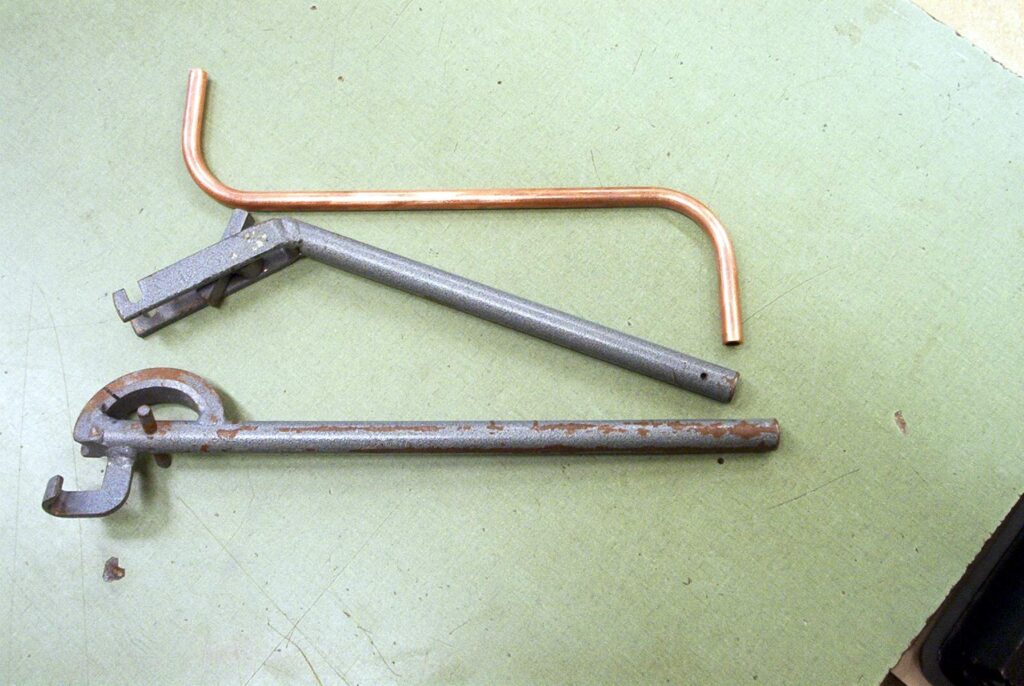
A manual bender isn’t a lesser tool. It’s a different trade: less money and more feel, in exchange for more effort.
How hydraulic benders work: cylinder, pump and stroke
A hydraulic rotary-draw bender replaces your arm with a hydraulic cylinder. The cylinder pushes on the bender’s arm, and the arm turns the die. A pump feeds oil to the cylinder. The pump is the part that changes between hand, air and electric setups.
Cylinder size and stroke
Makers usually say which cylinder suits their bender. JD2 recommends a 10-ton cylinder with a 14″ stroke for the Model 32 (JD2). Pro-Tools sells a hydraulic package for the 105HD with a 10-ton cylinder (Pro-Tools). Use the cylinder your maker specifies. A bigger cylinder doesn’t raise the bender’s rated capacity.
The cylinder can only push so far in one stroke. On some benders, one stroke doesn’t cover a full bend. Rogue Fab says its M605 bends about 94° per stroke and can continue past 180°. Past one stroke, you reset the cylinder and keep going. Plan for that on hoops and U-bends.
Pressure as a gauge
A pressure gauge on the pump gives you a number to watch. JD2’s Model 32 manual says average bending pressure is usually below 1,300 psi. Its example of 1-3/4″ × .095″ mild steel is about 900 psi (JD2 manual). Your numbers will differ. But logging them helps you spot a tube that’s fighting harder than it should.
The ram trap
“Hydraulic” in a listing doesn’t tell you the bending method. A hydraulic ram pipe bender pushes the middle of the work like a press. It’s made for heavy pipe, and it tends to flatten tube. A hydraulic rotary-draw bender is a different machine. Read our pipe bender vs tube bender guide if you’re unsure which one you’re looking at.
A hydraulic kit raises capacity only where the maker rates it. Always check the capacity chart for the hydraulic setup. Don’t assume more force means you can bend anything.
Where manual runs out: OD, wall and material
The big question is simple: when does hand power stop being enough? There’s no universal number. But makers publish useful thresholds, and they point the same way.
What makers say
- JD2 Model 32: manual bending of round tube over 2″ × .120″ needs hydraulics. JD2 also lists square tube over 1-1/2″ and solid bar over 1″ as hydraulic jobs. With hydraulics, JD2 rates it to 2″ × .250″ DOM.
- Pro-Tools 105HD: round tube to .134″ wall by hand, including 2″ × .134″ 4130 with the extension handle.
- Eastwood High Capacity: 2″ × .120″ mild steel, with 4130 limited to .090″ wall. It runs manual or with Eastwood’s hydraulic kits.
- Rogue Fab M605: built around hydraulic drives. Its wall limit is listed as .188″ in the catalogue and .250″ DOM in the FAQ, a conflict worth asking Rogue Fab about.
The four things that push you toward hydraulics
- Wall thickness. Thicker wall takes more force. Going from .095″ to .120″ to .188″ makes a big difference.
- Outside diameter. Bigger tube needs more force at the same wall. JD2’s manual limit, for example, sits at 2″ × .120″.
- Material. 4130 chromoly is stronger than mild steel. JD2 also says it springs back about twice as much, so you bend further.
- Bend count. A cage can have dozens of bends. Effort that’s fine for one bumper adds up fast.
Building with chromoly? Our best tube bender for chromoly guide covers the extra demands. And our bend calculator helps you plan cut lengths, so fewer bends end up as scrap.
Decision table: which drive fits you
Here’s the core of this guide. Find your situation in each row, then look at where most of your answers land. If they mostly land on the left, manual is fine. If they mostly land on the right, plan for hydraulics.
| Factor | Manual is usually fine | Manual now, hydraulic-ready | Go hydraulic |
|---|---|---|---|
| Tube OD | Up to about 1.75″ | 1.75″ to 2″ | 2″ and up |
| Wall | Thin to medium, within the maker’s manual rating | Near the manual limit | Over the manual limit (for example, JD2: over 2″ × .120″) |
| Material | Mild steel | Mostly mild, some 4130 | Regular 4130 or thick DOM |
| Volume | A few projects a year | Growing project list | Cages, frames or paid work |
| Budget | Tight; dies come first | Spread the cost over time | Ready for a bigger investment |
| Space | Room for a long handle swing | Room now, tighter later | Tight bay; no room for a handle |
| Power | None needed | Compressor or outlet available later | Steady shop air or a suitable outlet |
| Your body | Happy to pull | Fine now, thinking ahead | Shoulder, back or grip limits |
The OD and volume bands are rules of thumb, not maker specs. Your bender’s capacity chart always wins.
Most people land in the middle column. That’s why a hydraulic-ready manual bender is such a common choice. Not sure where you sit? Our Find My Bender quiz asks about your tube, projects and space, then explains its answer.
Bender upgrade kits: going hydraulic later
An upgrade kit turns a manual rotary-draw bender into a hydraulic one. It’s a big part of why “manual now, hydraulic later” works. But kits differ a lot, so check what you’re buying.
What makers offer
- Eastwood High Capacity: air-over-hydraulic and electric-hydraulic conversion kits, both sold on Amazon.
- JD2 Model 32: a hydraulic adapter kit sold direct (JD2). JD2’s own listings disagree on whether the cylinder is included, so ask before you order.
- Pro-Tools 105HD: a hydraulic package with a 10-ton cylinder, sold direct.
- Woodward Fab: lists an air/hydraulic version of its bender, the WFB2-AHP (Woodward Fab). Check with Woodward Fab before assuming a kit fits an existing WFB2.
- Rogue Fab M605: offered with manual hydraulic, air-over-hydraulic, or 1.5 HP and 2.0 HP electric-hydraulic drives.
What to check before you buy a kit
- Exact fit. Kits are made for one bender model. Confirm yours by model number.
- What’s in the box. Cylinder, pump, hoses, gauge and mounting brackets. Some are sold separately.
- Power. Air pressure for air kits, voltage and motor size for electric ones.
- New capacity. Find the maker’s chart for the hydraulic setup.
- Stroke vs angle. Know how many degrees one stroke gives, and how to reset.
Want the details on cylinders? See our guide to the hydraulic cylinder for a tube bender. These picks are based on published specs and listings, not hands-on testing. Read how we evaluate equipment.
As an Amazon Associate I earn from qualifying purchases.
Eastwood air-hydraulic conversion kit
Eastwood Air-Hydraulic Conversion Kit for the High Capacity Bender
Turns Eastwood’s manual High Capacity bender into an air-over-hydraulic machine.
This kit adds an air-driven hydraulic drive to the Eastwood High Capacity bender. Instead of pulling the handle, you let shop air run the pump.
Who it’s for: owners of the High Capacity bender who already have a solid compressor and want easier, steadier bends.
How to check it fits: it’s made for the Eastwood High Capacity bender. Check your compressor can hold the working pressure through a full bend.
- Drive
- Air-over-hydraulic
- Working pressure
- About 90 psi
- Fits
- Eastwood High Capacity bender (#21115)
- Needs
- Steady shop air
Why it’s worth a look
- Big cut in effort per bend
- Smooth, steady motion helps consistency
- No electrical work needed
Know before you buy
- A small compressor may struggle
- Fits the Eastwood bender only
- Air hose adds clutter around the bender
Affiliate link. See our disclosure.
Eastwood electric-hydraulic conversion kit
Eastwood Electric-Hydraulic Conversion Kit (0.75 HP, 110 V)
Adds an electric hydraulic pump to Eastwood’s High Capacity bender.
This kit uses an electric motor to drive the hydraulic pump. You don’t need a big compressor, just a suitable outlet.
Who it’s for: High Capacity owners with a small compressor, or anyone who wants the least effort per bend.
How to check it fits: it’s made for the Eastwood High Capacity bender. Check the outlet and circuit you’ll plug it into against the kit’s listing.
- Drive
- Electric-over-hydraulic
- Motor
- 0.75 HP
- Power
- 110 V
- Fits
- Eastwood High Capacity bender (#21115)
Why it’s worth a look
- No compressor needed
- Lowest effort of any drive
- Good for long cage sessions
Know before you buy
- Adds a motor and pump to find room for
- Fits the Eastwood bender only
- Needs a nearby outlet
Affiliate link. See our disclosure.
Staying manual? Baileigh RDB-050
Baileigh RDB-050 Manual Rotary Draw Bender
A three-speed ratchet bender for people who want big manual capacity without hydraulics.
If you’d rather skip pumps and hoses, a strong ratchet is the other way to tame big tube. The RDB-050’s three speeds let you move fast early and fine-tune late.
Who it’s for: builders who bend 2″ tube or 4130 by hand and have room for a heavy machine. Baileigh lists its net weight at 310 lb.
How to check it fits: Baileigh rates it to 2.5″ × .120″ mild steel and 2″ × .120″ 4130. Its copy lists both 190° and 200° as the max bend.
- Drive
- Manual, 3-speed ratchet
- Speeds
- 4°, 8° or 12° per pull
- Mild steel
- Up to 2.5″ OD × .120″ wall
- 4130 chromoly
- 2″ OD × .120″ wall
- Extras
- Anti-springback mechanism
Why it’s worth a look
- High manual capacity
- No power or air needed
- Anti-springback holds the bend between pulls
Know before you buy
- No hydraulic upgrade listed
- Heavy; plan your anchoring
- Dies add a lot to the total
Affiliate link. See our disclosure.
Air over hydraulic vs electric over hydraulic
Once you’ve decided on hydraulics, the next choice is the pump. Both types push oil to the same kind of cylinder. The difference is what powers the pump, and what that asks of your shop.
Air over hydraulic
An air-over-hydraulic pump uses compressed air to drive a small hydraulic pump. Eastwood’s air kit runs at about 90 psi working pressure. The catch is supply. Your compressor has to keep up for the whole bend, and through a session of many bends. A small pancake compressor may struggle and cycle constantly.
Electric over hydraulic
An electric-over-hydraulic pump uses a motor instead. Eastwood’s kit is 0.75 HP on 110 V. Rogue Fab offers 1.5 HP and 2.0 HP electric-hydraulic drives for its M605. There’s no compressor to feed. You do need a suitable outlet near the bender, and you should check the circuit against the maker’s listing.
| Question | Air over hydraulic | Electric over hydraulic |
|---|---|---|
| What powers it? | Compressed shop air | An electric motor |
| Example spec | Eastwood: about 90 psi working pressure | Eastwood: 0.75 HP, 110 V; Rogue Fab: 1.5 or 2.0 HP |
| Best if you have | A strong compressor already | A small compressor, or none |
| Watch out for | Compressor can’t keep up | Outlet and circuit near the bender |
| Extra clutter | Air hose | Power cord |
Before you buy an air kit, look at your compressor’s tank and rated output. If it runs constantly during other air-tool jobs, it’ll likely struggle here too. An electric kit may save you a compressor upgrade.
Want a deeper look at pumps alone? Read our electric vs air-over-hydraulic bender pump guide.
Ergonomics, space and setup
Capacity charts don’t show what it’s like to bend for an afternoon. Ergonomics, space and setup can matter as much as tons and wall thickness.
Your body
Manual bending is real physical work. Thick wall means hard pulls, often from awkward angles. A ratchet helps by breaking one big pull into many smaller ones. Hydraulics go further. You stand back, run the pump and watch the degree ring. That’s easier on shoulders, backs and grip, and it often makes long sessions more consistent too.
Space
A manual bender needs room for the handle to swing, and that swing can be wide. A hydraulic setup trades the handle for a cylinder, a pump and a hose or cord. Either way, the tube itself still sweeps through an arc as it bends. Plan clear space on both sides of the die. Many builders set up near the garage door so long sticks can poke outside.
Anchoring
Both types push hard against their base. A smooth hydraulic stroke can feel gentle, but the forces are still large. Anchor the stand to a sound concrete floor as the maker directs. Heavy machines like the 310 lb RDB-050 need a plan before delivery day.
One person or two?
With a long manual handle, a second person can help steady long tube. With hydraulics, one person can often run the whole bend while keeping an eye on the tube. Either way, keep helpers and kids out of the swing zone. Our workshop safety notes cover the basics.
Real-life lessons from garage builders
These are composite stories. The same situations come up again and again in garage-fab forums and build threads. Each one shows a different side of the manual vs hydraulic decision.
A builder starts a full cage on a manual bender. The first few bends are fine. By the twentieth, their shoulder is sore and the bends are getting less consistent. They add the maker’s electric-hydraulic kit and finish the cage with steady, even pulls.
Lesson: bend count matters as much as tube size. A hydraulic-ready frame saves you from starting over.
Someone buys an air-over-hydraulic kit to save money. Their small compressor runs non-stop, and the bend stalls while it catches up. They end up buying a bigger compressor, which costs more than the electric kit would have.
Lesson: check your air supply before you choose an air kit.
A first-time builder buys a full hydraulic setup for a couple of mild-steel bumpers a year. The bends come out fine, but the money could have bought two more dies.
Lesson: buy for the work you’ll really do. Manual now, hydraulic-ready, is often the smarter path.
Common mistakes (and how to fix them)
Most drive-type regrets come from a short list of mistakes. Here they are, with the fix for each.
❌ Buying a hydraulic ram “pipe bender” for tube. “Hydraulic” isn’t the same as rotary draw.
✅ Fix: make sure the machine clamps tube to a die and draws it around. That’s what keeps tube round.
❌ Buying a kit that doesn’t fit. Upgrade kits are made for specific benders.
✅ Fix: match the kit to your bender’s exact model, and confirm with the maker if in doubt.
❌ Assuming the cylinder or pump is included. Some kits and listings leave parts out, or disagree.
✅ Fix: list every part you need and check each one against the listing. Ask the maker when listings conflict.
❌ Pairing an air kit with a small compressor. The bend stalls while the tank refills.
✅ Fix: check your air supply first, or go electric.
❌ Treating hydraulics as a capacity cheat. More force doesn’t raise the frame’s or die’s rating.
✅ Fix: stay within the maker’s chart for your hydraulic setup.
❌ Forgetting the stroke limit. A big bend can need more than one cylinder stroke.
✅ Fix: learn your bender’s reset routine on scrap before your first hoop.
❌ Skipping the anchors because it “feels smooth.” Hydraulic force is still huge.
✅ Fix: anchor the stand to concrete exactly as the maker directs.
Pro tips from experienced benders
These habits make either drive easier, safer and more repeatable.
- 💡 Buy the frame for the future. If there’s any chance you’ll go hydraulic, choose a bender with an upgrade kit from its maker.
- 💡 Spend on dies first. A manual bender with the right dies beats a hydraulic one with the wrong die.
- 💡 Log pressure and springback. With a gauge, note the pressure for each tube size. A sudden jump can warn you about a hard batch.
- 💡 Use big steps, then small ones. On a ratchet, move fast early and switch to the smallest step near your target.
- 💡 Test-bend every new material. JD2 says 4130 springs back about twice as much as mild steel. Find your number on scrap.
- 💡 Plan the hose or cord. Route it away from the tube’s swing and your feet.
- 💡 Keep the handle. Even after a hydraulic upgrade, a manual handle can be handy for quick, small jobs if your bender allows it.
Don’t pick the drive for your easiest part. Pick it for the thickest, biggest or most numerous bends you’ll realistically make. That’s where manual either holds up or doesn’t.
Comparing whole machines rather than drives? Our best hydraulic tube bender guide and the bender type comparison are good next stops.
Frequently asked questions
Is a hydraulic tube bender better than a manual one?
Not always. Hydraulics make thick wall, 4130 and long builds much easier. But a manual bender handles a lot of mild-steel garage work for less money. The bend quality comes from the die and the method, not the drive.
When do I need a hydraulic tube bender?
When your tube is beyond the maker’s manual rating, or you bend a lot. JD2, for example, says its Model 32 needs hydraulics for round tube over 2″ × .120″. Regular 4130 work and full cages also push people toward hydraulics.
Can I add hydraulics to my manual bender later?
Often, yes, if the maker offers a kit. Eastwood, JD2 and Pro-Tools all list hydraulic options for their benders. Check the kit fits your exact model and what’s included.
Is air over hydraulic or electric over hydraulic better?
Air over hydraulic suits shops with a strong compressor. Eastwood’s air kit runs at about 90 psi. Electric over hydraulic suits shops with a small compressor or none. Eastwood’s electric kit is 0.75 HP on 110 V.
Does a hydraulic bender bend tighter radii?
No. The die sets the centerline radius. Hydraulics only change how the force is applied, so the same die gives the same radius either way.
Is a hydraulic pipe bender the same as a hydraulic tube bender?
Usually not. Most hydraulic “pipe benders” are ram presses made for heavy pipe. A hydraulic tube bender is normally a rotary-draw machine that clamps tube to a die.
Your manual vs hydraulic decision checklist
Tick through these before you choose a drive or buy an upgrade kit.
- I’ve listed my tube ODs, walls and materials for the next year or two
- I’ve checked each one against the maker’s manual capacity chart
- I know whether I’ll bend 4130 regularly
- I’ve estimated how many bends my biggest project needs
- I’ve decided: manual, manual hydraulic-ready, or hydraulic
- If hydraulic-ready, the maker sells a kit for my exact bender
- I’ve confirmed what the kit includes (cylinder, pump, hoses, gauge)
- For an air kit, my compressor can keep up
- For an electric kit, I have a suitable outlet near the bender
- I’ve planned floor anchors and clear swing space
- I’ve budgeted for dies before drive upgrades
Manual or hydraulic, the bender is only as good as the die, the anchors and the habits behind it. Choose the drive for your hardest realistic job, leave room to grow, and spend the savings on dies and practice tube. 💪
Still deciding between manual and hydraulic?
Answer a few quick questions and get a recommendation with the reasons behind it. Or plan your first part with the bend calculator.
Keep reading
Tube Bender Comparison Chart: 7 Benders by Published Specs
Our tube bender comparison lines up JD2, Rogue Fab, Baileigh, Pro-Tools, Woodward Fab, Eastwood and Harbor Freight, with a source for every…

Best Tube Bender (2026): Top Picks for Every Job
The best tube bender depends on the job. Research-based picks for home garages, roll cages, chromoly, exhaust and production, with sourced specs.
Best Tube Bender for a Home Garage (2026 Guide): What to Buy, What to Skip
Looking for the best tube bender for a home garage? Compare rotary-draw benders by capacity, dies and upgrade path, and avoid the…