Tube Bender Comparison Chart: 7 Benders by Published Specs
Our tube bender comparison lines up JD2, Rogue Fab, Baileigh, Pro-Tools, Woodward Fab, Eastwood and Harbor Freight, with a source for every published spec.

Shopping for a tube bender feels like comparing apples, oranges and the odd hydraulic jack. Every maker lists different numbers in a different way. One quotes DOM wall. Another quotes chromoly. A third only talks about pipe. This tube bender comparison lines up seven popular machines on one page, so you can see what each maker actually publishes.
We cover the JD2 Model 32, Rogue Fab M605, Baileigh RDB-050, Pro-Tools 105HD, Woodward Fab WFB2, Eastwood High Capacity and the Harbor Freight 12-ton ram-style pipe bender. Every number comes from the maker’s own page, its manual or a retail listing for that exact machine. Every machine gets a source link. Where two sources disagree, we show both. Where a number isn’t published, we say so instead of guessing.
One thing this page is not: a test report. Nobody at Benders Hub has run these machines side by side. Think of it as a carefully checked spec sheet, plus plain-English notes on what the numbers mean for your projects. By the end, you’ll know which machines can bend your tube on paper, and which questions to ask before you buy.
On published specs alone, here’s how the seven shake out:
- Biggest published capacity: the JD2 Model 32 with hydraulics (2″ × .250″ DOM) and the Baileigh RDB-050 (2.5″ × .120″ mild steel).
- Clearest chromoly ratings: the Pro-Tools 105HD (2″ × .134″ with its extension handle) and the Baileigh RDB-050 (2″ × .120″).
- Easiest Amazon entry points: the Woodward Fab WFB2, or the Eastwood High Capacity if you want a hydraulic upgrade later.
- Not a tube bender: the Harbor Freight 12-ton is a ram pipe bender. Its manual says it isn’t meant for thin-wall pipe.
📋 In this comparison
- How this comparison works
- The master comparison table
- Where the published specs disagree
- The three benders sold on Amazon
- The three benders sold direct
- The Harbor Freight 12-ton
- Drive options compared
- Dies: the other half of the comparison
- Which bender fits which project?
- Common comparison mistakes
- Pro tips
- FAQ
- Your comparison checklist
How this tube bender comparison works
Every row in this comparison comes from a published source. That means the maker’s product page, the maker’s manual, or a retail listing for that exact machine. We checked them in October 2026. Specs change, so treat this as a snapshot and click through before you buy.
We followed three simple rules. First, if a number isn’t published, the cell says “Not published”. We don’t fill gaps with forum guesses. Second, if two sources disagree, we show both and mark the cell with ⚠️. Third, we never mix test results into a spec sheet. Nobody at Benders Hub has bent tube on these seven machines, so there are no “real-world” scores here. You can read more about how we research equipment.
Why does this matter? Because tube bender listings are hard to compare. One maker rates its machine in DOM wall thickness. Another adds a chromoly figure. A third rates it in Schedule 40 pipe, which is a different sizing system. Put them in one table without care and you’d be comparing apples with hydraulic jacks.
What we compared
- Type and drive: rotary draw or ram, and whether it’s a lever, a ratchet or hydraulic.
- Round tube range: the outside diameter (OD) the maker lists.
- Max wall: the thickest mild steel or DOM wall the maker publishes.
- 4130 chromoly: only when the maker gives a separate figure.
- Max bend angle: including how the dies change it.
- Where it’s sold: Amazon, a store, or direct from the maker.
A blank cell only means we couldn’t find the number in an official source. The machine may handle that job fine. Ask the maker, and get the answer in writing before you order tube.
As an Amazon Associate I earn from qualifying purchases.
The master tube bender comparison table
Here’s the whole field on one screen: seven machines, six specs and a source link for each row. The first six are rotary-draw benders. That’s the type most garage builders use for bumpers, sliders, frames and cages. The last one is a ram-style pipe bender. It’s here because people often shop it against the others, and it helps to see why it’s a different tool.
| Bender | Type and drive | Round tube OD | Max wall (mild steel / DOM) | 4130 chromoly | Max bend | Where sold | Source |
|---|---|---|---|---|---|---|---|
| JD2 Model 32 | Rotary draw; manual ratchet, hydraulic option | 1/2″–2-1/2″ tube and pipe | 2″ × .250″ DOM with hydraulics. Over 2″ × .120″ needs hydraulics | No separate max published | Not stated. JD2 sells 180° die sets | Direct from JD2 | JD2 |
| Rogue Fab M605 | Vertical rotary draw; hydraulic ram | Up to 2.00″ | ⚠️ .188″ (catalogue) vs .250″ DOM (FAQ) | No separate max. Rogue groups 4130 with other carbon steel | About 94° per stroke; continues past 180° | Direct from Rogue Fab | Rogue Fab |
| Baileigh RDB-050 | Rotary draw; manual 3-speed ratchet | 3/4″–2.5″ | 2.5″ × .120″ | 2″ × .120″ | ⚠️ 190° (spec table) vs 200° (copy) | Amazon | Baileigh |
| Pro-Tools 105HD | Rotary draw; manual ratchet, hydraulic package sold | 1/2″–2″, plus NPS 1/4–1-1/2 pipe | .134″ max round wall | 2″ × .134″ with the 36″ extension handle | 180° (die-dependent) | Direct from Pro-Tools | Pro-Tools |
| Woodward Fab WFB2 | Rotary draw; manual lever | Up to 2″ | Not published for the frame. Die listings show .134″ | Not published | Depends on the die: 120° and 180° die families listed | Amazon | Woodward Fab |
| Eastwood High Capacity | Rotary draw; manual, air- or electric-hydraulic kits | ⚠️ 1″–2″ (Eastwood) vs 3/4″–2″ (one Amazon bullet) | 2″ × .120″ | .090″ wall max | 180° with 240° dies | Amazon | Eastwood |
| Harbor Freight 12-ton | Ram (bottle-jack press); hand pump | Not rated for tube. 1/2″–2″ Sch 40/80 pipe | Pipe only. Not for thin-wall pipe | Not rated | Up to 90° | Harbor Freight | Harbor Freight |
How to read this table
Start with the max wall column. It’s the one that rules machines out fastest. “Bends 2-inch tube” means very little on its own, because 2″ × .065″ wall is easy and 2″ × .120″ wall takes far more force. Then check the 4130 column if you plan to bend chromoly. Makers usually rate it lower than mild steel, and two of the seven don’t publish a separate figure at all.
Next, look at max bend. A roll bar main hoop or a U-shaped bed bar needs well over 90°. Finally, check where each machine is sold. Three are on Amazon. Three are sold direct by the maker. One lives in Harbor Freight stores.
We haven’t picked a winner in those cells. The next section shows both numbers side by side, with links, so you can ask the maker which one applies to your tube.
Where the published specs disagree
Conflicting specs are normal. Makers update machines, old pages linger, and retailers copy text from different years. The trouble starts when a buyer sees the bigger number, plans a project around it, and finds out later it was the old rating. So here’s every conflict we found while building this comparison.
| Bender | One source says | Another source says | What to do |
|---|---|---|---|
| Rogue Fab M605 (wall) | Catalogue and category page: 2.00″ × .188″ | FAQ: up to .250″ DOM | Ask Rogue Fab which applies. Its M625 is rated 2.00″ × .250″ DOM. |
| Rogue Fab M605 (stroke) | Product page: about 94° per ram stroke | Other Rogue pages: 90° per stroke | Minor. Plan on re-stroking for big bends either way. |
| Baileigh RDB-050 (angle) | Spec table: 190° | Product copy: 200° | Plan around the lower figure until Baileigh confirms. |
| Eastwood High Capacity (OD range) | Eastwood page: 1″ to 2″ | Amazon listing: one bullet says 3/4″, another says 1″ | Confirm a die exists in your size before you buy. |
| JD2 Model 32 (manual limit) | JD2: round tube over 2″ × .120″ needs hydraulics | One retailer’s copy reads like .250″ wall by hand | Go by JD2’s own wording and ask JD2. |
| JD2 Model 32 (availability) | JD2’s product page is still up | One retailer lists it as discontinued | Call JD2 before planning around it. |
| Woodward Fab WFB2 (angle) | Woodward lists 180° die sets | Retail die listings show about 110°–120° | It depends on the die family. Check each die’s listing. |
| Woodward Fab WFB2 (handle, weight) | Retail listings and the maker’s page disagree on handle length and weight | Check the listing you actually buy from. | |
Why the numbers drift
Most conflicts have a boring cause. A maker beefs up a frame and updates one page but not another. A retailer copies an older description. Or a spec table and the marketing copy were written by different people. None of that means anyone is lying. It does mean you should confirm the number that matters to your project.
The simplest fix is an email. Give the maker your exact tube: OD, wall, material and the die you plan to use. Ask, “Is this within the rated capacity of my machine?” A clear yes in writing is worth more than any spec table, including ours.
When two official numbers disagree, the right answer isn’t the bigger one. It’s the one the maker confirms for your exact tube.
The three rotary-draw benders sold on Amazon
Three of the seven machines are listed on Amazon. That makes them easy to order, return and pair with dies from the same listing family. Here’s what each maker publishes, who each one suits, and what to check before you click “buy”. These notes are based on published specs, listings and what owners commonly report, not on our own bending.
Woodward Fab WFB2
A plain manual frame for round and square tube up to 2″.
Buy from AmazonEastwood High Capacity
Manual now, with air- or electric-hydraulic kits later.
Buy from AmazonBaileigh RDB-050
2.5″ mild steel and 2″ chromoly, with a 3-speed ratchet.
Buy from AmazonWoodward Fab WFB2
Woodward Fab WFB2 Manual Tube & Pipe Bender
A manual rotary-draw frame for tube up to 2″ with the right die.
The WFB2 is a lever-operated rotary-draw bender with a degree ring. Woodward Fab sells round, square and Schedule 40 pipe dies for it. The maker lists steel, aluminum and copper as materials.
Who it’s for: weekend builders bending mild steel for bumpers, racks, kart frames and shop projects.
What to check: Woodward doesn’t publish a single max wall for the frame. Wall limits sit on each die listing, so read the die page for your size.
- Type
- Manual rotary draw
- Tube size
- Up to 2″ with the matching die
- Max wall
- Die listings: .134″ (e.g. 2″ × 6″ CLR)
- Bend angle
- Depends on die: 120° and 180° families
- Powered versions
- WFB2-AHP (air) and WFB2-EHP (electric), sold separately
- Sold separately
- Dies and stand
Strengths on paper
- Simple design that’s easy to learn
- Round, square and pipe dies listed
- Maker says its dies also fit its WFPB1000 hydraulic bender
Know before you buy
- No published chromoly rating
- Handle length and weight differ between listings
- Manual only unless you buy a powered version
Add-ons: WFB2 stand · 2″ OD × 6″ CLR die. Affiliate links. See our disclosure.
Eastwood High Capacity (#21115)
Eastwood High Capacity Tube Bender (#21115)
Bend by hand now. Add air- or electric-hydraulic power later.
Eastwood rates this bender to 2″ × .120″ mild steel and limits 4130 to .090″ wall. Its 240° dies allow full 180° bends. With the 120° dies, Eastwood’s instructions recommend 90° as the max.
Who it’s for: builders who want 180° hoops and a clear upgrade path, without buying a hydraulic machine on day one.
What to check: dies, handle and stand are sold separately, so price the whole kit. If you bend 3/4″ tube, confirm a die exists, because the listings disagree on the smallest size.
- Type
- Manual rotary draw, hydraulic-ready
- Tube size
- 1″–2″ OD (Eastwood); listing also mentions 3/4″
- Mild steel
- Up to 2″ × .120″
- 4130 chromoly
- Limited to .090″ wall
- Bend angle
- 180° with 240° dies
- Power kits
- Air (90 psi working) or electric (0.75 HP, 110 V)
Strengths on paper
- Clear published mild steel and 4130 limits
- Two hydraulic upgrade kits
- 240° dies for full 180° bends
Know before you buy
- Several parts sold separately
- Lower chromoly wall limit than some rivals
- Eastwood says its dies are for round tube only
Add-ons: air-hydraulic kit · electric-hydraulic kit · 1.75″ × 6″ CLR 240° die. Affiliate links. See our disclosure.
Baileigh RDB-050
Baileigh RDB-050 Manual Rotary Draw Bender
A heavy manual bender rated for 2.5″ mild steel and 2″ chromoly.
The RDB-050 has the biggest published mild steel OD of the three Amazon machines. A three-speed ratchet gives 4°, 8° or 12° per pull, and an anti-springback mechanism holds the bend while you reset the handle.
Who it’s for: serious hobbyists and small shops that bend 2″ tube or 4130 by hand.
What to check: RDB-050 dies are model-specific. Baileigh’s own drop-on die sets for its other benders are marked “Not RDB-050”. Also note each die set’s wall basis, covered in the dies section below.
- Type
- Manual rotary draw, 3-speed ratchet
- Mild steel
- 3/4″ to 2.5″ OD, .120″ wall
- 4130 chromoly
- 2″ OD × .120″ wall
- Bend angle
- Baileigh lists both 190° and 200°
- Max CLR
- 7″
- Dies
- 90° and 180° sets made for the RDB-050
Strengths on paper
- Highest mild steel OD of the Amazon three
- Published 4130 rating at .120″ wall
- Ratchet speeds help with big tube by hand
Know before you buy
- A bigger investment than entry-level frames
- Manual only
- Dies won’t swap with Baileigh’s drop-on sets
Check die availability for your tube size before ordering. Affiliate link. See our disclosure.
The three benders sold direct from the maker
Three of the most talked-about garage benders aren’t on Amazon. You buy them from the maker or its dealers. They have deep die catalogues and long track records in build threads. Here’s what each maker publishes.
JD2 Model 32
The Model 32 is a horizontal rotary-draw bender for 1/2″ to 2-1/2″ OD round tube and pipe. JD2 describes it as a heavier-duty version of its Model 3, with larger 1-1/4″ alloy pins. By hand, it uses a ratchet lever with an extension, about 36″ in total. JD2 says round tube over 2″ × .120″ needs its hydraulic add-on. With hydraulics, it’s rated to 2″ × .250″ DOM (JD2).
The Model 32 manual suggests a 10-ton cylinder with a 14″ stroke. Listings differ on whether the cylinder and pump come with the hydraulic kit, so check the package. JD2’s page doesn’t state a max bend angle, but JD2 sells 180° die sets. Who it suits: builders who want a manual start with a proven hydraulic path. Sold direct from JD2.
Rogue Fab M605
The M605 is a vertical rotary-draw bender driven by a hydraulic ram. You can power it with a hand pump, air-over-hydraulic, or a 1.5 or 2.0 HP electric pump. Rogue rates it to 2.00″ OD. Its catalogue says .188″ wall, while its FAQ says .250″ DOM. Rogue lists about 94° per ram stroke, and the machine keeps going past 180° with re-strokes.
Rogue says its M601, M605 and M625 share dies. Moving from an M605 to an M625 needs a frame swap, but the dies, hydraulics and cart carry over. Who it suits: builders who want hydraulic power from day one and like a vertical layout. Sold direct from Rogue Fab.
Pro-Tools 105HD
The 105HD handles 1/2″ to 2″ OD round tube up to .134″ wall, plus NPS 1/4 to 1-1/2 pipe. Pro-Tools rates it on mild steel Schedule 40 pipe and lists 180° bends, depending on the die. The package includes a stand, a degree plate and a 36″ extension handle. Pro-Tools says that handle gives enough torque to bend 2″ × .134″ chromoly by hand (Pro-Tools).
Pro-Tools gives a minimum CLR of about 3 × OD and a max CLR of 7″. A hydraulic package is also sold. Who it suits: builders who bend chromoly by hand and want a published 4130 number. Sold direct from Pro-Tools. Comparing these two closely? See Pro-Tools 105HD vs JD2 Model 32.
The Harbor Freight 12-ton: a different kind of tool
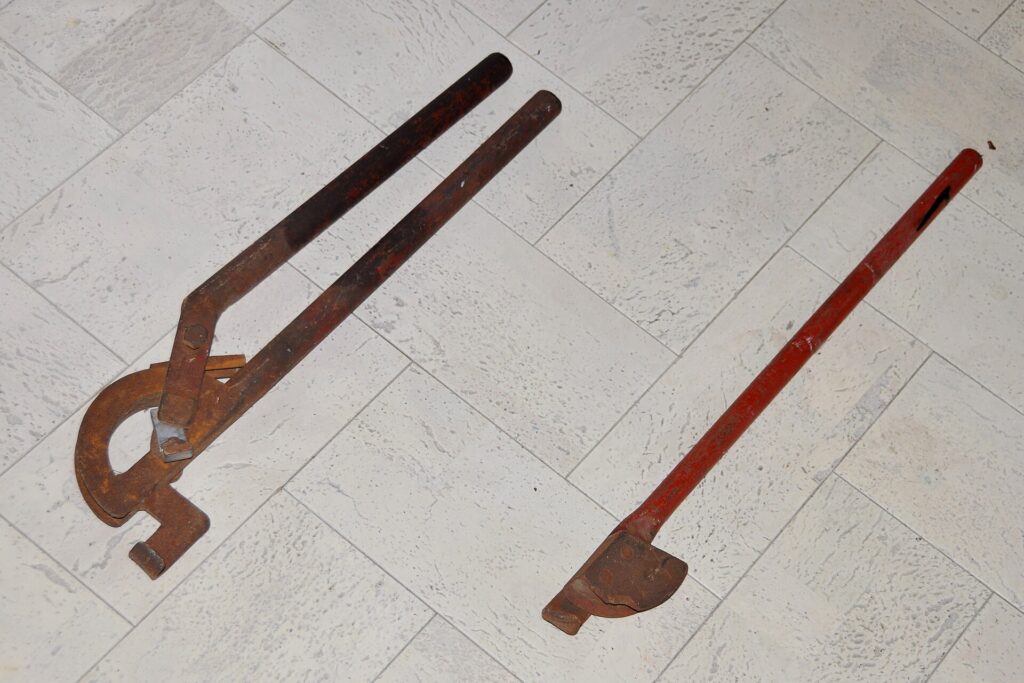
The Central Machinery 12-ton hydraulic pipe bender (item 32888) sells in Harbor Freight stores. It’s a ram bender. A bottle jack pushes a cast shoe into the middle of the pipe while two supports hold the ends. Rotary-draw benders work differently. They clamp the tube to a round die and draw it around that die.
Harbor Freight rates it for 1/2″ to 2″ Schedule 40 and 80 pipe, with six cast dies, a 9-1/2″ stroke and bends up to 90° (Harbor Freight). The key line is in its manual. It says the bender is not intended for thin-walled pipe such as conduit or exhaust pipe.
So why is it in a tube bender comparison? Because many first-time buyers compare it with the others on tonnage. Tonnage isn’t the right yardstick. A 12-ton press can easily flatten a tube that a manual rotary-draw bender bends cleanly. The type of bend matters more than the force behind it.
Who it suits: people bending heavy-wall pipe for gates, railings, farm and shop jobs, where a slightly flattened bend is fine. Who it doesn’t suit: anyone building bumpers, sliders, frames or roll cages from structural tube. Never use a ram bender for cage tube. Our full guide to the Harbor Freight 12-ton pipe bender covers what it’s good for.
A roll cage or roll bar must follow your sanctioning body’s current rulebook, including the bend radius. Ram benders don’t make the smooth, round, fixed-radius bends cage builders rely on. Use a rotary-draw bender and confirm with your rulebook and tech inspector. See our safety notes.
Manual, ratchet or hydraulic: drive options compared
“Drive” is how force gets into the tube. It affects how hard the work feels, how fast you bend, and how much wall you can pull. The table below shows what each maker publishes. It doesn’t rank them. A hydraulic option is only useful if you’ll actually bend tube that needs it.
| Bender | Standard drive | Power options the maker lists | Worth knowing |
|---|---|---|---|
| JD2 Model 32 | Ratchet lever, about 36″ with extension | Hydraulic adapter kit | Manual suggests a 10-ton cylinder, 14″ stroke |
| Rogue Fab M605 | Hydraulic ram | Hand pump, air-over-hydraulic, 1.5 or 2.0 HP electric | Hydraulics carry over to an M625 frame |
| Baileigh RDB-050 | 3-speed ratchet (4°, 8°, 12° per pull) | None listed | Anti-springback mechanism |
| Pro-Tools 105HD | Ratchet with 36″ extension handle | Hydraulic package | Extension handle is what unlocks the 4130 rating |
| Woodward Fab WFB2 | Manual lever | Separate WFB2-AHP and WFB2-EHP machines | We found no published kit to convert an existing WFB2 |
| Eastwood High Capacity | Manual handle (sold separately) | Air-hydraulic kit or electric-hydraulic kit | Air kit: 90 psi working; electric: 0.75 HP, 110 V |
| Harbor Freight 12-ton | Hand-pumped bottle jack | None | Ram press, not rotary draw |
How to choose a drive
Manual or ratchet suits most mild steel up to about 1.75″ with common walls. It’s quieter, simpler and teaches you how tube behaves. Hydraulic makes sense for 2″ tube, thick wall, chromoly and long cage builds. JD2’s own line is a useful marker: it says round tube over 2″ × .120″ needs hydraulics on its Model 32.
Check your shop before you choose a powered option. An air-over-hydraulic kit needs steady shop air. An electric pump needs the right outlet. For a deeper look, read manual vs hydraulic tube benders.
Dies: the other half of every comparison
The bender frame is only half the purchase. Every tube size and every centerline radius (CLR) needs its own die set. On all six rotary-draw machines here, you buy dies separately. Over time, most builders spend more on dies than on the frame. So a fair tube bender comparison has to include the die side.
What the makers say about die fit
- JD2: its FAQ says the only interchange between current models is Model 3 dies in a Model 4. No other current models are interchangeable (JD2 FAQ).
- Rogue Fab: dies are shared across the M601, M605 and M625. Benders built from 2023 use a 7/8″ main pin, and older ones may use 3/4″, so check yours.
- Baileigh: the RDB-050 uses its own die sets. Baileigh’s drop-on sets for its other rotary-draw benders say “Not RDB-050”.
- Pro-Tools: dies are labelled for the 105 Standard Duty and Heavy Duty benders.
- Woodward Fab: dies fit the WFB2 and the WFPB1000 hydraulic bender.
- Eastwood: High Capacity dies come in 120° and 240° versions, for round tube only.
No maker in this group says its dies fit another brand’s bender. So for cross-brand fit, the honest answer is unknown, ask the maker. Our full guide to tube bender die compatibility goes deeper, and our compatibility tool helps you plan a setup.
These are composite stories. The same situations come up again and again in garage-fab forums and build threads.
A builder finds a used 1.75″ die online for a different brand of bender. It looks close, and the seller says “should fit”. The pin hole is the wrong size, and the die sits too low on the frame. It goes back up for sale a week later.
Lesson: die fit is brand-specific. Only trust a fit statement from the maker or the retailer selling it.
Which bender fits which project?
Specs only matter when they meet a real project. The table below matches common garage jobs to the machines whose published numbers cover them. “Covers it on paper” doesn’t mean it’ll be easy, and it doesn’t replace the maker’s confirmation. Off-road dies often sit around 1.5″ and 1.75″ OD, which Baileigh’s blog lists with roughly 5.5″ and 6.5″ CLR.
| Project | Typical tube | Machines whose published specs cover it | Watch out for |
|---|---|---|---|
| Bumpers, sliders, racks | 1.5″–1.75″ mild steel | All six rotary-draw machines, with the right die | Wall limits on each die listing |
| 2″ heavy-wall DOM | 2″ × .250″ | JD2 Model 32 with hydraulics; M605 per its FAQ (⚠️ catalogue says .188″) | Manual limits and the M605 conflict |
| 2″ 4130 chromoly | 2″ × .120″–.134″ | Baileigh RDB-050 (.120″); Pro-Tools 105HD (.134″ with extension handle) | Eastwood caps 4130 at .090″ wall |
| 180° hoops | Varies | Eastwood (240° dies), Baileigh, Pro-Tools, M605, JD2 and WFB2 180° die sets | Buy the 180°+ die version |
| Gates and railings in pipe | Sch 40/80 pipe | Harbor Freight 12-ton; Pro-Tools 105HD for NPS 1/4–1-1/2 | Pipe is sized by NPS, not OD |
| Roll cages | Set by your rulebook | Rotary-draw machines only | Rulebook tube size, wall and bend radius |
Notice how the chromoly row shrinks the list fast. That’s the point of a comparison like this. Start with your hardest tube, not your easiest. If you’re unsure about pipe sizes, our guide to pipe bender vs tube bender explains NPS and OD.
Someone plans a buggy frame in 1.75″ × .120″ 4130. They shortlist three machines on price. Then they check the 4130 column. One of the three caps chromoly at .090″ wall. The shortlist drops to two before they spend a cent.
Lesson: filter by your hardest material and wall first. Price comes second.
Common tube bender comparison mistakes (and fixes)
Most comparison regrets come from reading the specs too quickly. Here are the mistakes we see most often in forum threads, with a simple fix for each.
❌ Comparing tonnage across bender types. A 12-ton ram and a manual rotary-draw bender aren’t on the same scale.
✅ Fix: compare the type first, then the published OD, wall and material ratings.
❌ Reading only the OD. “2-inch capacity” says nothing about wall or material.
✅ Fix: match OD, wall and material together, using the maker’s own wording.
❌ Picking the bigger number when specs conflict. The bigger figure may be from an older page.
✅ Fix: plan around the lower figure, and ask the maker to confirm the higher one in writing.
❌ Assuming mild steel ratings cover 4130. Several makers rate chromoly lower.
✅ Fix: look for a separate 4130 figure. If there isn’t one, ask before you buy.
❌ Ignoring the die’s own limits. A die can be rated for less wall than the machine.
✅ Fix: read each die listing’s wall and CLR notes, not just the bender’s headline.
❌ Assuming dies swap between brands. No maker here says they do.
✅ Fix: budget for dies from the same maker as your bender, unless a maker or retailer states otherwise.
Pro tips for comparing benders yourself
Specs change, and new machines appear. These habits let you run your own comparison any time, with any brand.
- 💡 Write down your hardest tube first. OD, wall and material. That one line rules out more machines than anything else.
- 💡 Save the source page. Take a screenshot or PDF of the spec page on the day you buy. If a rating changes later, you’ll know what you were sold.
- 💡 Price one die with every bender. Compare “frame plus your first die”, not frame alone.
- 💡 Check the die family’s angle. Many makers sell 90° or 120° dies and separate 180°+ dies. The bender’s max angle only matters if you buy the long die.
- 💡 Look for a published 4130 figure. If you’ll ever bend chromoly, a machine with a stated rating saves you a lot of guessing.
- 💡 Ask about pins and versions. Rogue Fab, for example, says benders built from 2023 use a 7/8″ main pin, while older ones may use 3/4″. Older machines can need different dies or bushings.
- 💡 Run the geometry. Our bend calculator shows D of bend and wall factor for your tube and die, so you can spot tough combinations early.
Before you buy, email the maker your tube size, wall, material and planned die. Ask if it’s within the rated capacity. How fast and clearly they answer tells you a lot about the support you’ll get later.
Want to see the different machine types side by side, not just these seven? Our bender type comparison lays out lever, ram, rotary-draw and mandrel benders.
Frequently asked questions
Which tube bender is best in this comparison?
It depends on your hardest tube. On published specs, the Baileigh RDB-050 has the biggest mild steel OD of the Amazon machines, the JD2 Model 32 has a 2″ × .250″ DOM rating with hydraulics, and the Pro-Tools 105HD has the clearest manual chromoly rating. Start with the table and filter by your tube.
Which tube bender can bend 2″ × .250″ DOM?
JD2 rates the Model 32 to 2″ × .250″ DOM with hydraulics. Rogue Fab’s FAQ gives the M605 .250″ DOM, but its catalogue says .188″, so ask Rogue Fab. Rogue rates its M625 to 2.00″ × .250″ DOM.
Can the Harbor Freight 12-ton bend tube for a roll cage?
No. It’s a ram pipe bender rated for Schedule 40 and 80 pipe, and its manual says it isn’t meant for thin-wall pipe. Cage tube needs a rotary-draw bender and a die that meets your rulebook.
Are dies interchangeable between these benders?
Not as far as any maker states. Some dies swap within a brand, such as Rogue Fab’s M601, M605 and M625. For cross-brand fit, ask the maker before you buy.
Which of these benders can make 180° bends?
Eastwood with its 240° dies, Pro-Tools 105HD, Baileigh RDB-050 and Rogue Fab M605 all list 180° or more. JD2 and Woodward Fab sell 180° die sets. The Harbor Freight ram bender goes up to 90°.
Is the JD2 Model 32 still made?
JD2’s product page is still up, but at least one retailer lists the Model 32 as discontinued. Contact JD2 for current status before you plan around it.
Your comparison checklist
Run through this list with the master table open. If every box is ticked, you’re comparing on the numbers that matter.
- I’ve written down my hardest tube: OD, wall and material
- I’ve ruled out ram benders for structural tube
- The maker’s published wall rating covers my tube, with headroom
- If I’ll bend 4130, the maker gives a separate chromoly figure
- I’ve checked every ⚠️ conflict for the machines on my shortlist
- I’ve emailed the maker to confirm my exact tube and die
- I’ve checked the max bend angle and the die family I need
- I’ve priced the frame plus my first die, not the frame alone
- I know which dies fit my machine, including pin size or version
- I’ve saved the spec page I’m buying from
That’s the whole field, on paper and side by side. Pick the machine whose published numbers cover your hardest tube, confirm it with the maker, and buy one good die to start. Your first project will thank you. ✅
Still deciding between bender types?
Answer nine quick questions for a recommendation with reasons, or compare the main bender types side by side.
Keep reading
Best Tube Bender (2026): Top Picks for Every Job
The best tube bender depends on the job. Research-based picks for home garages, roll cages, chromoly, exhaust and production, with sourced specs.
Best Tube Bender for a Home Garage (2026 Guide): What to Buy, What to Skip
Looking for the best tube bender for a home garage? Compare rotary-draw benders by capacity, dies and upgrade path, and avoid the…
Pipe Bender vs Tube Bender: Which One Do You Actually Need?
Pipe bender vs tube bender: how NPS pipe and OD tube differ, why a ram pipe bender kinks tubing, and which bender…