Mandrel Bending vs Crush Bending Exhaust: What Really Changes
Mandrel bending vs crush bending exhaust, explained simply: what each does to the pipe, when crush bends are fine, and when mandrel bends earn their cost.

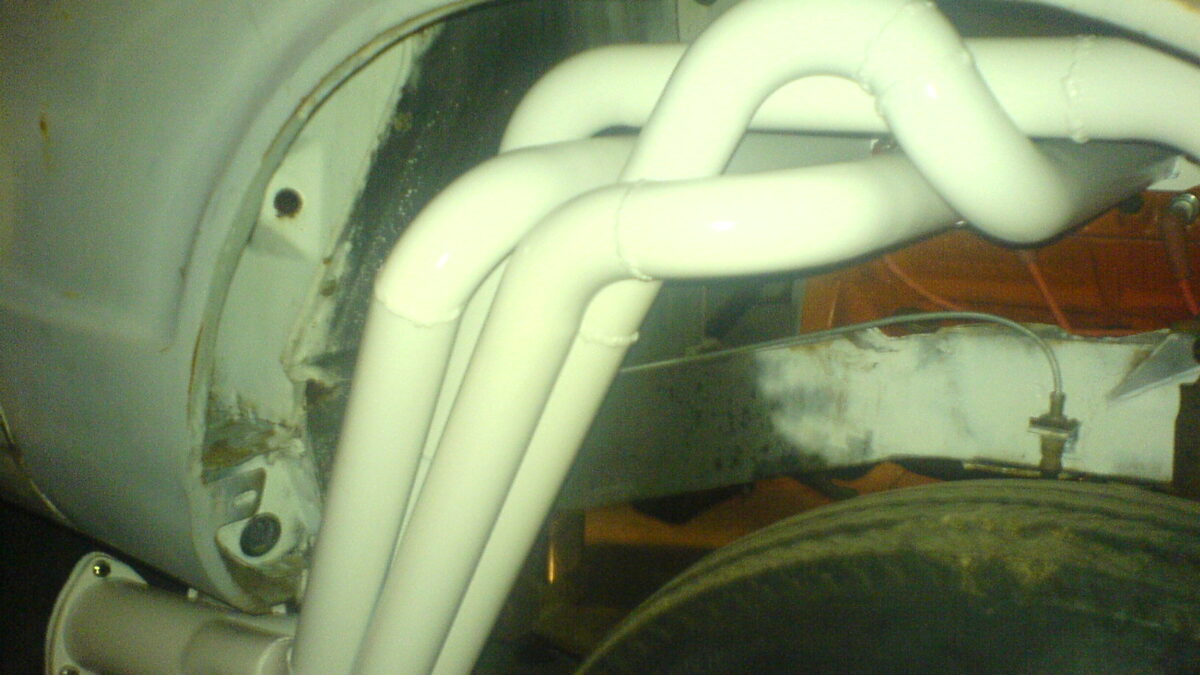
You’ve priced a custom exhaust and heard two shop words thrown around: crush bent and mandrel bent. One costs less. One looks nicer in photos. But what’s the real difference, and does it matter for your car? This guide on mandrel bending vs crush bending exhaust pipe answers that in plain English, without the forum hype.
Here’s the short version. Both methods bend the same thin-wall tube. The difference is what holds the tube’s shape while it bends. A crush bender pushes from the outside only, so the pipe flattens and wrinkles on the inside of the bend. A mandrel bender puts a support inside the tube, so it stays close to round. That one detail changes how the bend looks, how well it welds to the next piece, and how tight a corner you can turn.
We’ll also cover where rotary-draw bending fits in, because a garage tube bender is a rotary-draw machine, and people often ask if it can do exhaust. You’ll learn how to judge a bend with calipers, when a crush bend is perfectly fine, and when mandrel bends earn their extra cost. No made-up horsepower numbers. Just what’s known, and how to check it yourself.
Crush bends are made by pressing the pipe around a die with nothing inside it. The pipe flattens and wrinkles at the bend. Mandrel bends are drawn around a die with a support inside the tube, so they stay close to round.
- Crush bends are fine for: stock-style replacement pipes, gentle bends and tight budgets.
- Mandrel bends are worth it for: tight spaces, turbo and header work, and any system you cut and weld together.
- At home: buy pre-bent mandrel elbows like our 2.5″ 1.5D stainless elbow pick or a 2.5″ U-bend, then cut and weld.
📋 In this guide
- What crush bending is
- Mandrel bending and rotary draw
- Mandrel bending vs crush bending exhaust: the cross-section
- Side-by-side comparison
- When crush bends are fine
- When mandrel bends earn their cost
- Your options in a home garage
- Real-life lessons
- Common mistakes and fixes
- Pro tips
- FAQ
- Your exhaust bend checklist
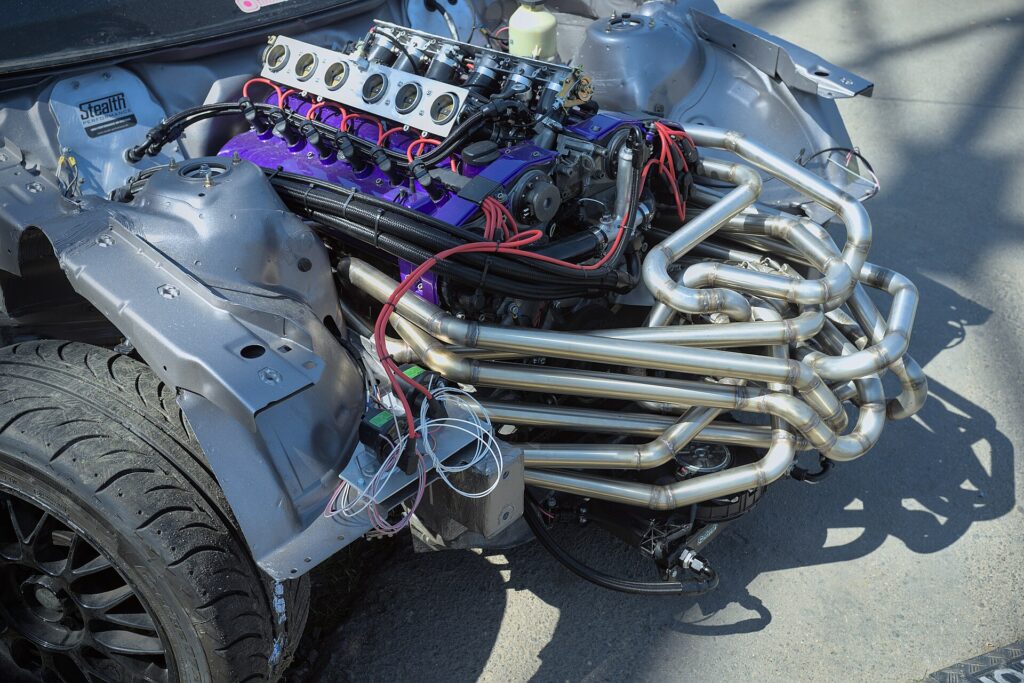
What crush bending is (and why muffler shops use it)
Crush bending goes by a few names. You’ll hear press bending, ram bending or compression bending. The idea is the same. A hydraulic ram pushes a curved die into the pipe while two shoes or rollers hold the back side. Nothing supports the inside of the tube.
The Fabricator, a long-running metal trade magazine, calls ram-type bending one of the oldest and simplest ways to bend tube. It says a centerline radius (CLR) of about three to four times the tube’s outside diameter (OD) is generally achievable this way (The Fabricator). CLR is the radius of the bend, measured to the middle of the tube. For 2.5″ exhaust, three to four times OD works out to roughly 7.5″ to 10″.
Why it’s everywhere
Rogue Fabrication, a bender maker whose range includes a mandrel exhaust machine, describes ram benders as the standard in muffler and exhaust repair shops. They’re quick to set up and the tooling is cheap. The trade-off, in its words, is that the pipe flattens and the inside of the bend wrinkles (Rogue Fab).
That trade-off is often acceptable. A shop can bend a replacement tailpipe while you wait. It doesn’t need a different mandrel for every tube size, and it can follow the shape of the old pipe by eye.
What happens to the tube
Picture the bend from the side. The outside of the curve (the heel) has to get longer. The inside (the throat) has to get shorter. With no support inside, thin wall takes the easy way out. The tube squashes into an oval, and the throat bunches up into ripples. The tighter the bend, the worse it gets.
The cheap 12-ton hydraulic “pipe benders” sold for plumbing pipe are a different tool again. Harbor Freight’s own manual for its 12-ton bender says it isn’t intended for thin-wall pipe such as conduit or exhaust (manual PDF). Expect kinks if you try.
Mandrel bending, and where rotary draw fits in
Mandrel bending is a form of rotary-draw bending. In rotary draw, the tube is clamped to a round bend die. The die rotates and draws the tube around itself, while a pressure die holds the outside. Your garage tube bender works this way. The Fabricator calls rotary draw the most versatile precision bending method (The Fabricator).
A mandrel bender adds one thing: a mandrel. That’s a rod, often with a row of linked balls on the end, that sits inside the tube right at the point where the bend starts. It holds the wall out from the inside, so the tube can’t collapse into an oval. Many setups also use a wiper die, a tool that sits against the throat and stops wrinkles from forming there.
How shops choose a mandrel
Tooling makers use charts with two numbers. D of bend is CLR divided by OD. Wall factor is OD divided by wall thickness (Pro-Tools). The Fabricator notes these charts are usually based on mild steel bent to 180° (The Fabricator). Exhaust tube scores badly on both. A 2.5″ × .065″ tube has a wall factor of about 38.5, and typical mandrel bends run at 1D to 1.5D. That’s thin wall at a tight radius, which is exactly the job mandrels exist for.
Can a garage rotary-draw bender do exhaust?
Without a mandrel, not at exhaust-style radii. Pro-Tools puts the practical minimum CLR for non-mandrel bending at about 3 × OD, and Baileigh suggests starting at 4 × OD (Baileigh). For 2.5″ tube, that’s a 7.5″ to 10″ CLR, much looser than a 2.5″ to 3.75″ mandrel elbow. Even Rogue Fab, which sells mandrel add-ons for its garage benders, says on its mandrel page that wall ratios over 30 and bends tighter than 2.5D are not likely possible with them. Our guide to mandrel benders for a home shop goes deeper.
Mandrel bending vs crush bending exhaust: the cross-section
If you cut both kinds of bend in half, the difference is obvious. A mandrel bend cut square to the tube looks close to a circle. A crush bend cut the same way looks like an egg, often with ripples along the throat. That shape is the whole story. Flow, fit-up and looks all follow from it.
Ovality: the number that describes the squash
Fabricators describe out-of-round tube with ovality. Measure the widest diameter and the narrowest diameter at the same spot. Then:
Ovality % = (widest − narrowest) ÷ nominal OD × 100
This is the common definition in tube-bending literature (see this IMEKO paper). Lower is rounder. You can check your own bends with calipers at two spots, 90° apart. Our ovality guide walks through it.
What the published numbers say
Honest data here is thin, and most of it comes from people who sell machines. Rogue Fab shows a 2.75″ exhaust tube bent at 1D with its mandrel and reports 0.9% deformation (Rogue Fab). On its mandrel page, it says rotary-draw bends on moderate wall ratios commonly show 5.5% to 11% deformation without a mandrel, versus about 1.8% to 2.5% with a properly set-up mandrel. Treat these as vendor figures, not independent tests. We found no published ovality numbers for typical muffler-shop crush bends.
What about flow?
Here’s what geometry can tell you for sure. An oval holds less area than a circle with the same perimeter. Ripples on the throat also disturb the gas as it passes. So a crush bend does narrow the passage at the bend. How much that costs in power depends on the engine, the pipe size, the bend count and how badly each bend is squashed. We couldn’t find a trustworthy, sourced percentage, so we won’t invent one. Be wary of anyone who quotes a single number for every car.
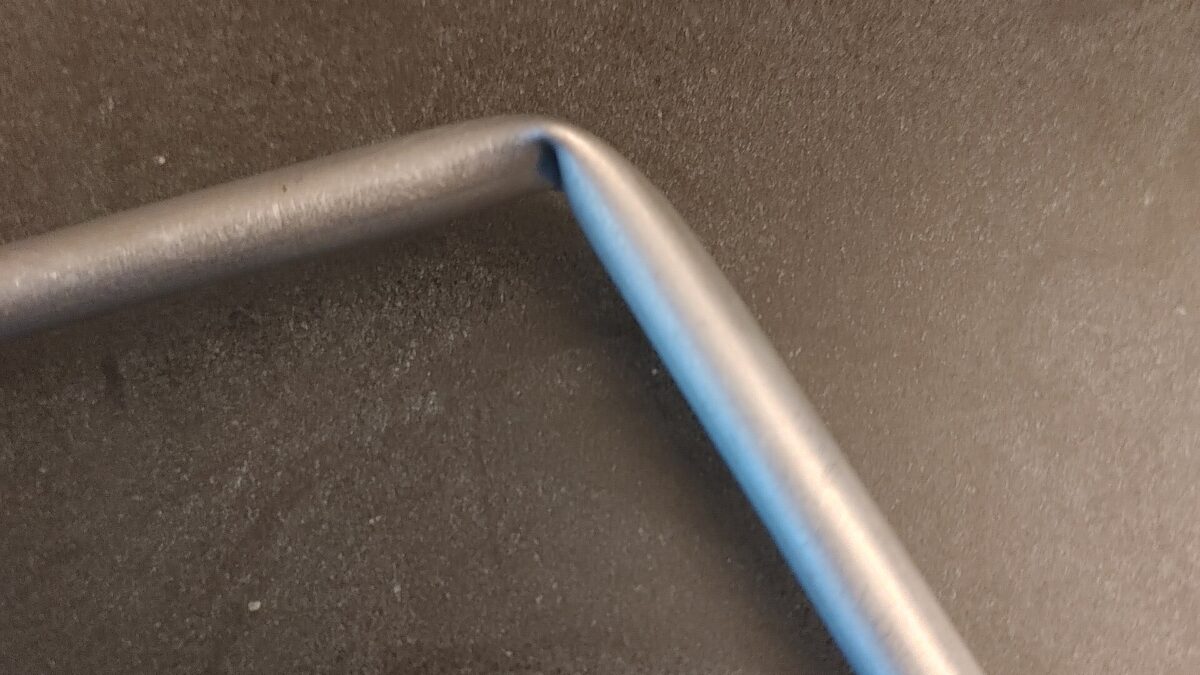
A crush bend isn’t wrong. It’s a trade: speed and low cost now, in exchange for a squashed, wrinkled section at every bend.
Side-by-side comparison
Here’s how the three methods stack up for exhaust work. The radius figures come from the trade and maker sources linked above. The rest is how each process works, not a test result.
| Feature | Crush (ram / press) bend | Rotary draw, no mandrel | Mandrel bend |
|---|---|---|---|
| Support inside the tube | None | None | Mandrel, often with a wiper die |
| Typical CLR | About 3–4 × OD is generally achievable (The Fabricator) | Practical minimum about 3 × OD (Pro-Tools) | 1D–1.5D is common in aftermarket exhaust bends |
| Cross-section | Flattened, with throat wrinkles | Better, but thin wall still ovals | Close to round |
| Cut and weld to the next piece | Oval ends fit poorly | Fair at large radii | Round ends butt up cleanly |
| Where you get it | Most muffler shops | Your own garage bender | Specialist shops, or pre-bent elbows and kits |
| Cost | Lowest | Dies for large exhaust radii add up | Highest per bend |
How to read this table: start with the space you have. If the pipe must turn a corner tighter than about three times its own diameter, crush and non-mandrel bends are out. Next, ask whether you’ll cut bends apart and weld them to other pieces. If yes, round ends matter a lot. Finally, look at budget. A crush-bent system from a local shop is often the cheapest way to get a pipe on the car.
Wondering how the radius numbers translate into real space under a car? Our 1D vs 1.5D vs 2D exhaust bend radius guide works through the geometry for common pipe sizes.
| D of bend | CLR on 2.5″ OD | CLR on 3″ OD | Who usually makes it |
|---|---|---|---|
| 1D | 2.5″ | 3″ | Mandrel only |
| 1.5D | 3.75″ | 4.5″ | Mandrel only |
| 3D | 7.5″ | 9″ | Practical minimum for non-mandrel rotary draw (Pro-Tools) |
| 4D | 10″ | 12″ | Baileigh’s starting estimate for rotary draw |
The CLR column is simple maths: CLR = D × OD. Plug your own sizes into our bend calculator to see D of bend and wall factor side by side.
When crush bends are perfectly fine
Forum threads can make crush bends sound like a crime. They aren’t. Muffler shops bend them every day, and they do the job on lots of everyday cars. Here’s when a crush bend is a sensible choice.
1. Stock-style replacement
If you’re replacing a rusted factory pipe on a daily driver, a muffler shop can copy the old shape quickly. If the factory routing uses gentle bends, the squash at each one stays modest. You get a working exhaust at a low cost, often the same day.
2. Gentle bends with room to spare
Crush bends hurt most when the radius is tight. If your routing only needs a few big, lazy bends, the squash at each one is smaller. Ask the shop to use the largest die that fits.
3. Sections you won’t cut apart
A crush bend’s oval shape matters most at a joint. If the shop bends one continuous pipe from flange to muffler, there are no cut bends to weld. The ends stay round because they’re straight tube.
4. Budget builds and “get it running” stages
Not every project needs a show-quality exhaust right away. A crush-bent pipe can get the car on the road while you save for the next stage.
First, “What’s the tightest radius your bender does in my pipe size?” Second, “Can you show me a bend you’ve cut in half?” A good shop will happily answer both. If the sample bend looks badly flattened, ask for bigger radii or look at mandrel parts.
Who it’s for: daily drivers, stock-power cars, work trucks and anyone on a tight budget. How to check it: look at the throat of each bend. Light ripples are normal for a crush bend. A deep crease or a visibly flat spot is worth questioning before you pay.
When mandrel bends earn their cost
Mandrel bends cost more because the machine, the tooling and the setup cost more. Here’s when that money buys you something real.
1. Tight spaces
A mandrel can hold tube round at radii a crush bender can’t reach. Aftermarket mandrel elbows are commonly sold at 1D and 1.5D. On 2.5″ pipe that’s a 2.5″ or 3.75″ CLR. Compare that with the 7.5″ to 10″ The Fabricator gives as generally achievable for ram bending. Around a transmission crossmember, a steering box or a turbo, that difference decides whether the pipe fits at all.
2. Turbo, header and high-power builds
When you’re chasing performance, you want the pipe you paid for to stay full size the whole way. Mandrel bends keep the cross-section close to round, so there are no squashed choke points in the run.
3. Cut-and-weld systems
This is the big one for home builders. Most garage exhausts are built from pre-bent elbows and straights. You cut each bend to the angle you need, then butt-weld the pieces. Round ends meet round ends with an even gap all the way around. That makes TIG or MIG welding far easier, and the joints look tidy. A crush bend cut in the middle gives you an oval end that won’t match a round straight.
4. Show cars and stainless
If the exhaust is on display, smooth bends look better. Stainless is also costly enough that you want every piece to fit first time. Our guide to aluminized vs stainless exhaust tubing helps you pick the material.
Sketch the routing and count every bend. Note the angle and the tightest radius each needs. That list tells you how many elbows to order, and whether a crush-bent section can handle the gentle parts.
Who it’s for: turbo and header builds, tight engine bays, stainless systems and anyone welding their own exhaust from parts. How to check it: look for a stated CLR, OD, wall and material on every listing before you order.
Your options in a home garage
You don’t need a mandrel bender to get mandrel bends. Here are the realistic paths, from cheapest to most involved.
- Have a muffler shop crush bend it. Fast and low cost. Best for stock-style routing with gentle bends.
- Buy pre-bent mandrel elbows, U-bends and J-bends. Cut them to the angles you need and weld them together. This is how most garage exhausts get built.
- Send a drawing to a mandrel bending shop. Some shops will bend a complete pipe to your measurements. Good for long runs with several bends.
- Buy a mandrel bender. This is a shop machine and a big investment. It makes sense for a business, not a one-off project.
Path 2 is the sweet spot for most readers. If you’d like to compare doing it yourself against paying a shop, see buying mandrel bends vs bending your own exhaust. And before you cut anything, our exhaust tube cut length guide shows the maths.
Here are two pre-bent parts that suit a 2.5″ cut-and-weld build. We picked them from published listing specs: OD, CLR, wall, material and leg length all stated. We have not used them hands-on. See how we choose products.
As an Amazon Associate I earn from qualifying purchases.
2.5″ 1.5D stainless 90° elbow
2.5″ Stainless 90° Mandrel Bend Elbow, 1.5D / 3.75″ CLR, 16GA
A short 304 stainless 90° elbow with 2″ legs, sold by Stainless Bros.
This is the classic building block for a stainless system. Use it as a full 90°, or cut it down to any smaller angle. The 1.5D radius is a middle ground: tight enough for most routing, but looser than a 1D elbow.
Who it’s for: builders welding a 2.5″ stainless cat-back or downpipe from parts. Buy one or two extra, because cut elbows get used up fast.
Good to know: the listing says each elbow is individually extruded, with laser-cut ends. Check that the 2″ legs leave enough straight for your clamp or welding fixture.
- OD
- 2.5″
- CLR
- 3.75″ (1.5D)
- Wall
- 16GA / .065″
- Material
- 304 stainless
- Legs
- 2″
Why we like it
- CLR, wall and legs clearly stated
- Short legs suit tight spaces
- Cuts down to any smaller angle
Know before you buy
- Stainless needs a welding setup that suits it
- Short legs leave little room for clamps
- Same title appears with other leg options, so check the one you order
Building in mild steel? Khaos Motorsports lists a 2.5″ 90° aluminized 16ga mandrel elbow 2-pack (check the listing for the radius). Affiliate links. See our disclosure.
2.5″ 1.5D stainless 180° U-bend
2.5″ Stainless 180° Mandrel Bend, 1.5D / 3.75″ Radius, 16GA, 6″ Legs
One U-bend you can cut into two 90s, or into several smaller angles.
A U-bend holds 180° of mandrel bend plus two straight legs. Many builders treat it as raw material. Cut it at the top for two matching 90s, or slice off 30° and 45° pieces as the routing needs.
Who it’s for: anyone building a full system who’d rather cut angles to suit than buy a pile of different elbows.
- OD
- 2.5″
- Radius
- 3.75″ (1.5D)
- Wall
- 16GA / .065″
- Material
- 304 stainless
- Legs
- 6″ and 6″
Affiliate link. See our disclosure.
Real-life lessons from exhaust builds
These are composite stories. The same situations come up again and again in garage-fab forums and build threads. Each one shows where crush or mandrel bends make the difference.
A builder’s daily driver rusts through its factory pipe. A local muffler shop crush bends a new one to the old shape, in 2.5″ aluminized tube, the same afternoon. The bends are gentle. The car sounds and drives the same as before, and the bill is small.
Lesson: for stock-style routing with gentle bends, a crush-bent pipe is a sensible, low-cost fix.
Someone is building a turbo downpipe in a cramped engine bay. The local shop’s bender can’t turn the pipe tightly enough without flattening it badly. The builder switches to 1D and 1.5D mandrel elbows, cuts them to angle, and tacks the pipe together in place. It clears the firewall with room to spare.
Lesson: when space is tight, the radius decides the method. Measure first, then pick mandrel parts that fit.
A builder buys a cheap crush-bent pipe, cuts it in the middle of a bend, and tries to weld it to a new straight. The cut end is an oval. The gap is wide on two sides and tight on the other two. The weld takes ages and still looks lumpy.
Lesson: if you plan to cut through a bend and weld it, start with a mandrel bend.
One more pattern: people who start with a shop-bent system often come back to mandrel parts for the second version. Not because the first one failed. Because by then they know exactly what they want, and they want every joint to fit.
Common mistakes (and how to fix them)
Most exhaust regrets come from a short list. Here they are, with the fix for each.
❌ Using a bottle-jack pipe bender on exhaust tube. It’s made for thick-wall pipe and kinks thin wall.
✅ Fix: use a shop’s exhaust bender, or buy pre-bent mandrel elbows.
❌ Cutting through a crush bend and expecting a round end. The cut face is oval and won’t match a straight.
✅ Fix: only cut through mandrel bends. With crush bends, cut in the straight sections.
❌ Ordering elbows without checking CLR and legs. “Mandrel bend” on a listing doesn’t tell you the radius.
✅ Fix: confirm OD, CLR, wall, material and leg length on the listing before you buy.
❌ Going tighter than you need. A 1D bend fits small spaces, but it’s harder to make and harder to source.
✅ Fix: use the largest radius that fits each spot. Save tight elbows for the places that need them.
❌ Trusting one-size-fits-all flow numbers. A quoted “percent lost” with no source tells you nothing about your car.
✅ Fix: judge bends by what you can measure: radius, ovality and how the joints fit.
❌ Measuring pipe size by eye. Exhaust tube is sold by outside diameter, and a small mismatch ruins a joint.
✅ Fix: measure the OD of the pipe you’re joining with calipers, and buy bends in that exact OD.
Pro tips for better exhaust bends
These habits come up again and again in build threads. None of them cost much. All of them save tube, time and frustration.
- 💡 Mock up before you cut. Tack pieces together on the car, check clearance, then pull it off for final welding.
- 💡 Draw a reference line. Run a straight marker line along each elbow before cutting. It keeps every piece in the same plane when you tack it.
- 💡 Buy one spare elbow. A miscut elbow happens to everyone. A spare saves a week of waiting.
- 💡 Leave clamp room. If a section must come apart for service, plan a straight section long enough for a band clamp or slip joint.
- 💡 Check ovality on suspect bends. Calipers at two spots, 90° apart, tell you more than a photo.
- 💡 Mix methods wisely. Crush-bent sections can handle gentle bends where no cuts are needed. Use mandrel elbows where space is tight or joints meet.
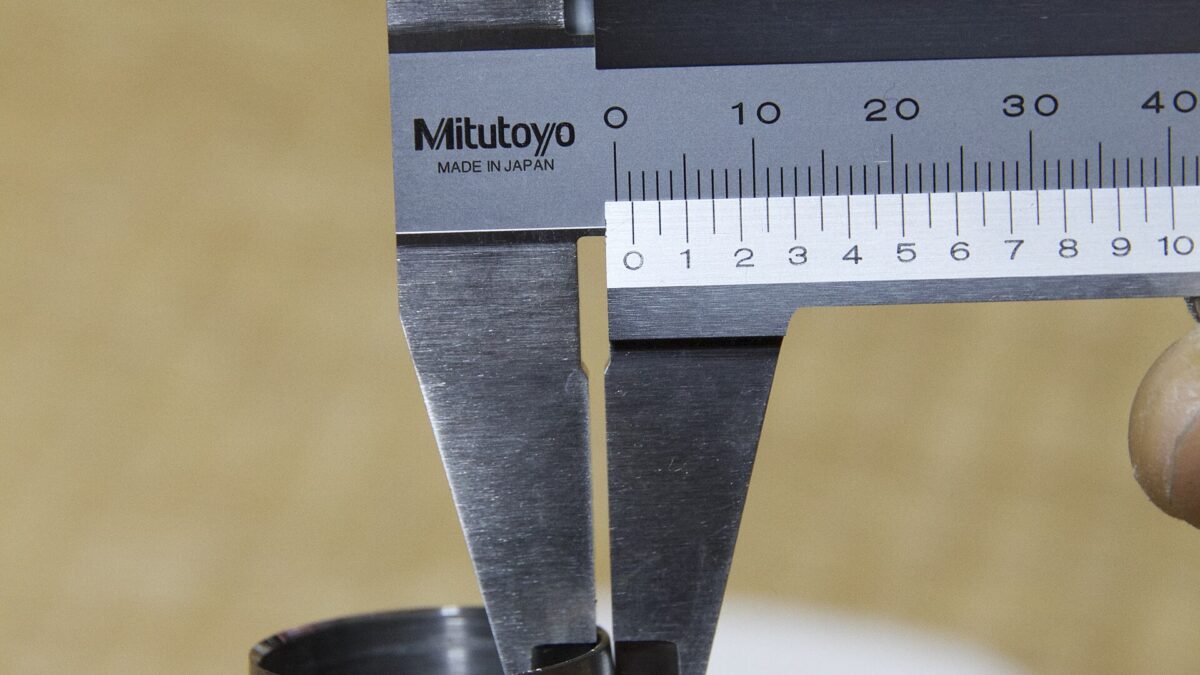
Experienced builders often pick one radius, such as 1.5D, for most of a system. Every elbow then has the same arc and tangent numbers. That makes cut lengths easier to work out, and the finished pipe looks consistent.
Want to see how a bend’s radius and angle change the tube it uses? Try our geometry visualizer, then look up any unfamiliar term in the glossary.
Frequently asked questions
Is mandrel bending better than crush bending for exhaust?
It keeps the pipe closer to round and allows much tighter radii, so it’s better for tight spaces, performance builds and cut-and-weld systems. For stock-style routing with gentle bends, crush bending is often good enough and costs less.
How much power does a crush-bent exhaust lose?
There’s no single honest number. A crush bend narrows the pipe at each bend, but the effect depends on the engine, pipe size, bend count and how badly each bend is flattened. We couldn’t find a reliable published figure.
Can I bend exhaust tubing with a garage tube bender?
Not at typical exhaust radii. Without a mandrel, Pro-Tools puts the practical minimum CLR at about 3 × OD. That’s 7.5″ on 2.5″ tube. Thin-wall exhaust tube is also prone to flattening. Pre-bent mandrel elbows are the usual garage route.
What is a crush bend?
A bend made by pressing the pipe around a die with a hydraulic ram, with nothing inside the tube. It’s fast and cheap. The pipe flattens and the inside of the bend wrinkles.
What does 1.5D mean on a mandrel bend?
It means the centerline radius is 1.5 times the tube’s outside diameter. On 2.5″ tube, 1.5D is a 3.75″ CLR.
Your exhaust bend checklist
Run through this list before you order parts or book shop time. If you can tick every box, you’re ready to build.
- I’ve measured the OD of the pipe and every flange, muffler and joint it meets
- I’ve sketched the routing and counted every bend
- I know the tightest radius each bend needs to clear the car
- I’ve decided which sections can be crush bent and which need mandrel bends
- I’ll only cut through mandrel bends, never crush bends
- Every elbow I order lists OD, CLR, wall, material and leg length
- I’ve picked aluminized or stainless and planned my welding for it
- I’ve worked out cut lengths before cutting any tube
- I’ve planned clamp room for any section that must come apart
- I’ve ordered at least one spare elbow
That’s the whole picture. Crush bends are a fast, honest fix for simple pipes. Mandrel bends are the right base for tight spaces and anything you cut and weld. Measure carefully, buy parts with clear specs, and your exhaust will fit like it came from a shop. 🔧
Ready to plan your pipe?
Work out arc length, tangent length and cut length for every bend. Or compare bender types before you buy tools.
Keep reading
Wall Factor and D of Bend: How to Read Any Mandrel Chart
Wall factor and D of bend explained: two simple ratios that predict wrinkles and flattening, how to read a mandrel chart, and…
Springback in Tube Bending: How to Measure and Correct It
Springback in tube bending, explained simply: why tube relaxes after a bend, how to find your number with a test bend, and…
Tube Bend Length Formula: Arc, Tangent and Cut Length Math
The tube bend length formula made easy: arc length, tangent length and cut length, with worked examples for one bend, hoops and…